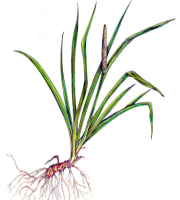
Sweet flag)
Botanical info:
Acorus calamus is an Eurasiatic perennial, aromatic, semi-aquatic herb, 60–150 cm tall, with long sword-shaped leaves and a thick creeping rhizome. It grows in marshes, along the margins of lakes and rivers, and in other wetlands.
It flowers from May to July.
Hippocratic legacy:
Hippocrates used Acorus calamus in the following ways:
a. In Diseases of Women 1:
-
To facilitate the expulsion of a dead fetus.
-
For cleansing the uterus after postpartum ulceration or in cases of uterine inflammation.
b. In Diseases of Women 2:
-
In cases of chronic displacement of the uterus.
Other uses:
In ancient Greece, Acorus calamus was used to prepare "Acorite Wine", renowned for its tonic and stimulating properties. It was also taken by athletes to strengthen their muscles.
Its rhizome, and to a lesser extent its leaves and stem, have been used since antiquity in Greek folk medicine, as well as in Ayurvedic and Traditional Chinese Medicine, where the plant has been employed to treat fever, induce vomiting in cases of indigestion, relieve digestive disorders and diarrhea, and as a sedative, nerve tonic, antimicrobial agent, expectorant, and remedy for chest pain.
In Western herbal medicine, it is used primarily for digestive complaints such as bloating, colic, and poor digestion, as well as headaches associated with digestive dysfunction, usually in the form of an infusion or a mild tincture.
However, Acorus calamus contains asarone, a potentially toxic compound whose use is subject to restrictions by the European Medicines Agency (EMA). For this reason, the Indian variety, which contains high levels of asarone, is generally avoided. Preference is given to North American and Siberian varieties, which are essentially free of this compound, while the European variety is considered acceptable because it contains only low concentrations.
Also:
-
The rhizome is consumed in crystallized form, known as "German ginger."
-
In Lithuania, it is used to flavour the traditional black bread Ajeras.
-
In Europe, Acorus calamus is often added to wine, and its rhizome is considered one of the possible ingredients of absinthe. It is also used in bitter liqueurs.
-
It is a source of essential oil valued not only for medicinal purposes but also for its insecticidal properties and in perfumery. The ancient Egyptians were among the first to use it extensively in perfume making.
-
Extracts from the rhizome are also used as flavour enhancers in tobacco products.
-
In all these applications, the permitted dosage is regulated because of the plant's content of α- and β-asarone.