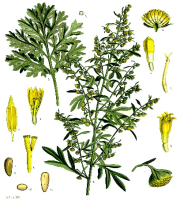
(Absinthe, Wormwood)
Botanical infο:
Wormwood is a greyish-green shrub native to temperate Eurasia and North Africa. It is distinguished by its characteristic aromatic scent and its yellow flowers, which bloom during the summer. It grows in dry soil, rocky slopes, and subalpine and alpine mountain habitats.
The genus name Artemisia is traditionally believed to derive either from Artemisia, the wife of Mausolus, or from the goddess Artemis.
Hippocratic legacy:
Hippocrates used absinthe in the following ways:
a. In Diseases of Women 1:
a. As an emmenagogue in the form of a vaginal pessary.
b. In Diseases of Women 2:
-
Against hysteria.
c. In On the Nature of Women:
-
As a disinfectant for the uterus.
-
For amenorrhea, as an emmenagogue.
Other uses:
Since antiquity, wormwood has been used as an antiseptic, emmenagogue, analgesic, stimulant and tonic, anthelmintic, and stomachic.
The European Medicines Agency (EMA) officially recognizes wormwood as a traditional herbal medicinal product for:
-
temporary loss of appetite;
-
mild dyspeptic and gastrointestinal disorders.
Because of its distinctive aroma, wormwood is also used as a culinary seasoning. It is an important ingredient in the production of “absinthe”, a spirit that can be harmful to the nervous system when consumed in excessive amounts because of its thujone content. However, it is also used safely in very low concentrations to flavour alcoholic and non-alcoholic beverages.
The dried leaves possess insect-repellent properties and have traditionally been used to protect clothing from moths.
Its flowering stems produce yellow dye used for coloring wool.
Wormwood is also cultivated as an ornamental shrub, particularly in gardens where its silvery grey-green foliage provides an attractive contrast in planting schemes.